
by Christina
If you’ve been learning English for a while, you might be wondering what comes after the basics. That’s where B2 English comes in. At this level, you move from being an “intermediate” learner to someone who can use English confidently in real situations – whether that’s at work, in study, or while travelling.
So, what exactly is B2? According to the CEFR (Common European Framework of Reference for Languages), it’s the upper-intermediate stage, where learners become “independent users.” In practical terms, it means you can follow the main ideas of complex texts, take part in discussions without too much effort, and write clearly about a wide range of topics.
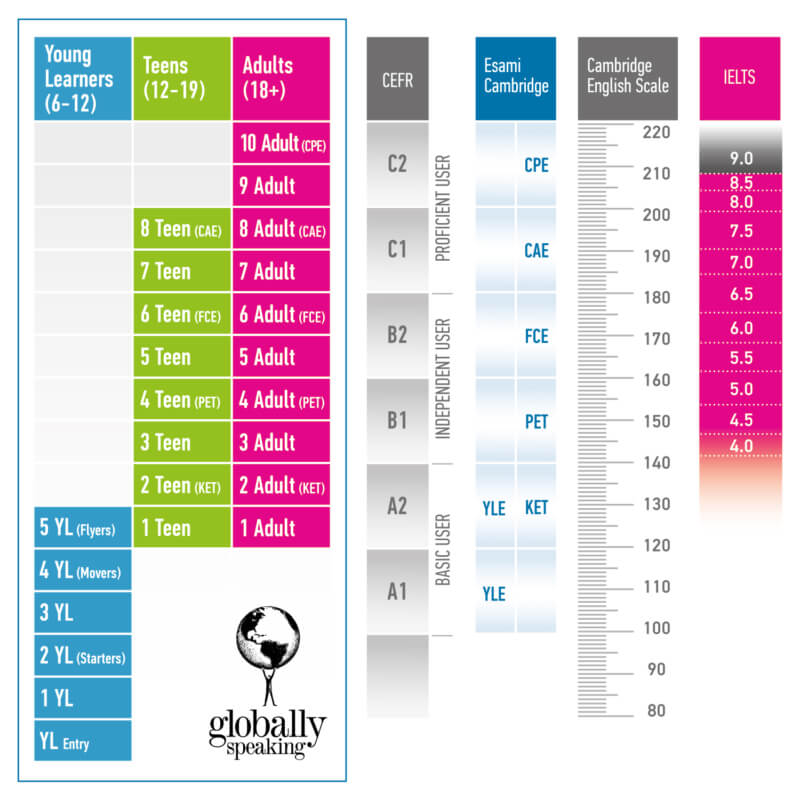
They’re designed for students who are already comfortable at B1 level, meaning you can manage everyday conversations, describe experiences, and understand simple written texts. If you want to improve your fluency, follow films or podcasts without subtitles, or prepare for international exams, then B2 is the next logical step.
You’ll work on all four skills: Reading, Writing, Listening, and Speaking. You’ll also build grammar and vocabulary knowledge, always with a focus on real communication. For example, you may practise writing an opinion essay, debating a current issue, or analysing longer reading passages. If you are preparing for the Cambridge B2 First (FCE) exam, lessons will also include exam strategies, practice tests, and tasks such as reports, reviews, and live speaking activities. Learn more about taking the B2 First exam with Globally Speaking
Reaching this level gives you practical advantages. Many universities and employers recognise the Cambridge B2 First certificate as proof that you can work or study in English. It also makes travel and international communication more straightforward. On a personal level, it builds confidence because you can communicate without needing to translate every word or pause too often.
The Council of Europe, which created the CEFR, recommends between 120 and 180 hours of study to progress from one level to the next. If you are moving from B1 to B2, this is the approximate amount of guided learning required, along with additional practice on your own. The exact time depends on how intensively you study, how much English you are exposed to outside the classroom, and how motivated you are.
At Globally Speaking, our B2 courses for adults and our B2 courses for teens are structured to help you progress efficiently. We combine skills development with exam preparation, and our teachers provide clear, practical feedback. Whether your goal is to pass the Cambridge exam or to use English more confidently in everyday life, we can support you in achieving it.
Reaching B2 is an important achievement and a clear step forward in your language learning. It’s the level where English becomes a reliable tool for study, work, and travel. If you’re ready to progress, a B2 English course can help you reach that goal.

Via Prisciano, 42
tel. (+39) 06 35340346
06 64560338
mobile: (+39) 327 9703457
segreteria@globallyspeaking.it
P.I. 12415031009
Dal lunedì al venerdì: 9:00-19:00
Sabato: 9:00-13:00
Globally Speaking S.r.l. P.IVA 12415031009 | All Rights Reserved